advertisement
28 September 2026
Arizona is an amazing and remarkably diverse state. It is best known worldwide for the Grand Canyon, the spectacular mile-deep gorge carved by the Colorado River over millions of years. But those of us who call Arizona home know there is much more to the Grand Canyon State than its most famous landmark.
Arizona is a place where you can find one of America’s largest cities, one of its snowiest communities, enormous pine forests, incredibly remote villages, vast tribal lands, and some of the sunniest weather anywhere on Earth.
Here are seven fascinating facts that show just how surprising Arizona really is.
advertisement
Phoenix is more than just a large city. It is the most populous state capital in the United States. According to U.S. Census Bureau population estimates for 2025, Phoenix had approximately 1.67 million residents, making it the fifth-largest city in the country. That puts Phoenix behind only New York City, Los Angeles, Chicago, and Houston.
Phoenix is even more populous than Philadelphia, San Antonio, San Diego, and Dallas. That’s quite a transformation for a city that began as a small agricultural community in the Salt River Valley in the 1800s.
Arizona’s reputation for sunshine is well deserved, but Yuma takes it further. Located in southwestern Arizona near the borders of California and Mexico, Yuma holds the Guinness World Record for the most sunshine. The city receives an average of approximately 4,055 hours of sunshine each year, representing about 91 percent of its possible daylight hours.
In other words, if you’re hoping for a sunny day in Yuma, the odds are very much in your favor. That abundant sunshine and warm winter weather have also helped make the area an important agricultural region and a popular destination for winter visitors.
Tell someone who has never visited Arizona that the state gets serious snowfall and you may receive a skeptical look. Then take them to Flagstaff. At roughly 7,000 feet and surrounded by ponderosa pine forest, Flagstaff experiences winters that look nothing like the cactus-filled landscapes many people associate with Arizona.
During the historic winter of 2022–23, Flagstaff recorded an astonishing 163.1 inches of snow. It was the fifth-snowiest winter since local records began in 1898. Nearby higher elevations receive even more snow, supporting winter recreation at destinations such as Arizona Snowbowl. Yes, you really can spend the morning skiing in Arizona and drive back toward the desert afterward.
The Navajo Nation is the largest Native American reservation in the United States, covering more than 27,000 square miles across portions of Arizona, New Mexico, and Utah. To put its enormous size into perspective, Navajo Nation lands are larger than 10 individual U.S. states. Known as Diné Bikéyah, or Navajoland, the region contains dramatic canyons, deserts, mesas, mountains, lakes, and some of the Southwest’s most recognizable landscapes.
Remember that the Navajo Nation is not simply an Arizona tourist attraction. It is a sovereign Native nation and the homeland of the Diné people, with its own government, communities, culture, traditions, and laws. Visitors can experience extraordinary destinations throughout Navajo lands, but should always respect tribal regulations, closures, permits, and culturally significant places.
Arizona may be famous for the Sonoran Desert, but drive north from Phoenix and the saguaros eventually give way to something completely different: towering pine trees. Coconino National Forest alone covers approximately 1.8 million acres of remarkably varied terrain, stretching from the Verde Valley to the high country surrounding Flagstaff. The forest is part of the vast ponderosa pine ecosystem stretching across northern and central Arizona and contains mountains, lakes, volcanic landscapes, red rock country, and high-elevation forests.
The elevation differences are equally impressive. Coconino National Forest extends from lower elevations near the Verde Valley to the San Francisco Peaks. Humphreys Peak rises to 12,633 feet, making it Arizona’s highest point. It is one of the best examples of how dramatically Arizona’s landscape can change over a relatively short distance.
West of Phoenix, surrounded by desert, sits one of the country’s most important power-generating facilities. The Palo Verde Generating Station is the largest power generator in the western United States and the nation’s largest producer of carbon-free electricity. The nuclear generating station has three units and can produce approximately 4,200 megawatts of electricity, enough generating capacity to serve around four million homes and businesses.
Palo Verde is particularly unusual because of its location. Unlike many nuclear power plants, it is not located beside a large natural body of water. Instead, the facility uses treated wastewater from the Phoenix metropolitan area as part of its cooling process. In a state famous for finding creative ways to live in an arid environment, even Arizona’s largest power plant has an unusual desert connection.
Deep within Havasu Canyon lies Supai Village, home of the Havasupai people and one of the most isolated communities in the contiguous United States. There is no road into Supai. Residents and authorized visitors reach the village by trail or helicopter, and the community’s unusual location has resulted in one of America’s most fascinating postal routes. The United States Postal Service still uses mules to carry mail and supplies into Supai. Mule trains travel about nine miles down into the canyon to reach the Supai Post Office, continuing a tradition dating back to the 1930s.
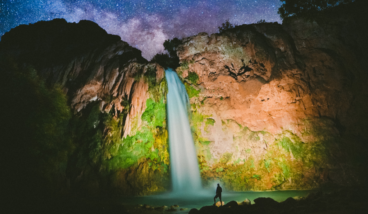
The village is located on the Havasupai Reservation and is closely associated with the spectacular blue-green waterfalls of Havasu Canyon, including Havasu Falls. Visiting isn’t as simple as showing up and hiking into the canyon. The Havasupai Tribe controls access to its lands, and visitors must obtain reservations and permits through the Tribe.
For more information, check out our Guide to Visiting Havasu Falls in the Grand Canyon. You can also read about a beginner’s first trip to Havasupai Falls.
advertisement
One of the easiest things to forget about Arizona is just how enormous and diverse the state really is. Within its borders are scorching deserts and snowy mountains, enormous cities and isolated villages, saguaro forests and towering ponderosa pines. Arizona contains landscapes shaped over millions of years alongside communities whose histories stretch back thousands of years.
You can watch the sunrise over the Sonoran Desert, stand beneath snow-covered pines, explore red rock country, gaze into the Grand Canyon, or travel through landscapes that seem to belong to completely different parts of the country, all without leaving Arizona.
The Grand Canyon may be what puts Arizona on postcards, but it is only the beginning of what makes this state extraordinary. For those of us lucky enough to call Arizona home, there is always something new to discover.
advertisement
Arizona is already home to some of the most spectacular landscapes in the country, and now one of its lesser-known natural wonders is getting national recognition. On October 20, 2026, Chiricahua National Monument was officially elevated to national park status. The designation makes Chiricahua Arizona’s fourth national park and the 64th national park in the United States. Located in southeastern Arizona’s Cochise County, near the town of Willcox, Chiricahua National Park is famous for its towering rock columns, gravity-defying balanced boulders, and extraordinary volcanic landscape. Although the area has been federally protected for more than a century, its new designation
Imagine a bird with a wingspan stretching nearly ten feet, soaring effortlessly above the Grand Canyon. It’s one of North America’s largest flying birds, capable of traveling enormous distances on rising currents of warm air. And just a few decades ago, the species nearly disappeared forever. The California condor is one of America’s most remarkable conservation success stories, and despite its name, Arizona has played a major role in bringing this magnificent bird back from the brink of extinction. Through captive breeding, carefully managed releases, wildlife monitoring, and cooperation between conservation organizations, Arizona helped establish a second wild population of
Imagine taking your children to a neighborhood playground on a sunny Arizona afternoon when you notice something moving through the grass nearby. At first, you might think it’s someone’s dog. But as it gets closer, you realize you’re looking at a coyote. Should you be alarmed? Why is a wild animal wandering around a playground in broad daylight? Isn’t it supposed to be hiding somewhere in the desert? Believe it or not, spotting a coyote in an unexpected place is not particularly unusual, especially in Arizona. Coyotes are among North America’s most adaptable wild animals, and they’ve become remarkably successful
Finding a rattlesnake in your yard can be alarming, especially if you have children or pets. But before you reach for a shovel or try to chase the snake away, remember one important thing: the safest rattlesnake encounter is usually the one where you keep your distance. Rattlesnakes are a natural part of life in Arizona, particularly in neighborhoods near washes, mountains, desert preserves, and undeveloped land. While their venom makes them potentially dangerous, rattlesnakes generally aren’t looking for a confrontation with people. Most would much rather escape than fight. If one turns up in your yard, knowing what to